Recent Rants

A Discussion of Terroir
July 11, 2026
Terroir is a term that is often bandied about with little understanding of what it truly represents. In the strictest sense, terroir represents the place from which a wine emanates. As the Cistercian monks discovered two thousand years ago, there is no better arbiter of place than the Pinot noir grape. But there is much to the concept which is simply not quantifiable and is in fact more spiritual because terroir can only be proven by the senses. For this reason it has long suffered from disdain by the scientific establishment (from whence I come). And yet I can attest that anyone who has worked closely with this grape, from several different vineyard sites, simply knows that terroir is for real.
The best description of terroir, I believe, belongs to Matt Kramer in his excellent book Making Sense of Burgundy*. He notes that in Burgundy there is a delight of differences and acceptance of ambiguity. In other words, the prize is for distinction over constancy…or a Oscar Wilde famously quipped “Consistency is the last refuge of the unimaginative”. The monks noticed early on that the wine derived from each parcel seemed to have definable characteristics which could found year after year. Specific aromatics, structure in the mouth, length of finish and so on came to define a given vineyard. Over time these defining attributes of each wine started to delineate them into groups based on quality. A wine from one block of grapes might always be preferred over that from an adjoining section. The monks decided that the terroir considered superior needed to be designated as such. And so came the classifications of Grand Cru, Premier Cru and Village Wines.
In its broadest sense, terroir is all of the things which influence the nature of the fruit. It is soil composition, depth of top soil and the underlying composition, angle of the slope, cardinal direction of the slope, elevation, latitude and longitude (which affects how the sun tracks across the sky through the growing season), precipitation (how much and what time of year it occurs) and of course overall weather associated with the site (temperature ranges through the year, wind events, etc.). Terroir is therefore basically everything that affects how the vine grows. And the trick for the winemaker is to allow the wine to go through the cellar without stylistic flourishes which might overwhelm the intrinsic terroir. In other words, the act of making Clos Electrique or Abbey Ridge must be separated from our egos as much as possible and allowed to develop as they will. Thus our wines are free of the aromas and flavors of oak and commercial yeast strains. Admittedly with this approach the wine sometimes is not to everyone’s liking but it will be a truer expression of the terroir for each wine.
As is the tradition in Burgundy, we chose to dry farm our vineyards (no irrigation). This is a critical choice in expressing terroir. Precipitation is absolutely a basic part of terroir. In fact it is my long held belief that irrigated vines might as well be grown hydroponically for the absence of terroir that they exhibit.
Finally, to quote Matt Kramer: “Without terroir, there is little reason for a winegrower to concern himself or herself with clonal selection, rootstocks, soil types or yields…without care for the exactitude of the resulting expression”.
*Matt Kramer Making Sense of Burgundy, 1990, William Morrow and Co.

Wine Economics and Mr. Rodgers' Neighborhood
May 15, 2026
Agriculture is a revolving stage of commodities that are at one point in high demand, which stimulates excessive planting of those commodities until suddenly the supply outstrips the demand. This is true of virtually every crop that you can imagine including wine grapes. It is especially tricky for perennial crops such as vineyards and orchards that take years to mature. Approximately 10-15 years ago the number of acres of newly planted Pinot noir in Oregon began to approach a tipping point. But it took about another 10 years for those vineyards to come into full production. So now, for the last couple of years, there has been more Pinot noir fruit for sale than wineries could (or wanted) to process.
From a buyer’s perspective this was a good thing because both the average grape price began to drop and the choice of sites and variety of clones to purchase began to increase. While this is a tough situation for the growers, ultimately it allowed for inferior vineyard sites and less attractive Pinot noir clones to be removed from the equation. While the present scenario of excessive Pinot noir both with respect to grapes as well as wine is stressful for many in the industry, it will ultimately result in an elevation of the overall quality of fruit and wine being produced in Oregon. It is in a way the ultimate playing out of the free market economy in which the best wines and vineyards survive while those on the margins disappear.
In practical terms, however, we have personally experienced some of the turmoil created by this turn of events. The 3-acre vineyard next door to Clos Electrique, which was slowly dying in part due to phylloxera, suddenly lost their lease to a local winery who no longer wanted to manage the vineyard or purchase the fruit. When the winery walked away from the property and left the vineyard untended, it suddenly became our problem as well as a problem for all the other wineries in our neighborhood. An unpruned and unfarmed vineyard suddenly becomes a potent source of powdery mildew which can spread its spores far and wide, infecting all the vineyards within a mile of its location.
Because our neighbor was no longer in a financial position to continue farming the property, and because a good portion of it was already dying of phylloxera, we proposed that Cameron Winery would undertake the removal of the entire vineyard. This was a huge project, requiring hours of labor extracting and recycling trellis wire and hiring an excavator to dig up and stack vines into piles which would eventually be burned. This was not a cheap exercise, but it had to be done.
While I was bemoaning the expense of this endeavor, I was unexpectedly contacted by two
nearby wineries who asked if they could help to pay for the removal project. This is one of many reasons why I love the wine industry: while we are competitors on one level, we are also friends and neighbors on another. I truly wish that the whole world could operate in this manner where problems are to be shared and solved together!


The Daffodil Index
March 22, 2026
One of my favorite winemakers and friends in the Dundee Hills is the iconic John Thomas (Thomas Vineyard). His approach to growing grapes and making wine in the Willamette Valley has been so unique as to earn him a special place in the genre of Oregon wine. I have had many conversations with John over the years, many quite memorable, but the one that has entered my winemaking lexicon is the “John Thomas Daffodil Index”. Every year in the early Spring as the weather starts to warm, the discussion among winemakers/viticulturists is invariably “when will the grape vines break bud this year”, that is, when will the little dormant buds pop open and initiate the new vintage season.
John came up with a method for determining this many years ago which he designated the “Daffodil Index”. Daffodils always pop up and start to bloom before the grapevines break bud. So John surmised that there was a discrete number of days after the daffodils started to bloom that the grapes would start to do their thing. The problem was that when I asked him what the time frame actually was, he had no idea. So two years ago I picked a specific block of daffodils to watch (keeping in mind that daffodils continuously pop up and start to bloom around the vineyard). Over those two years I have determined that the index is 26 days relative to my specific block of daffodils.
This year (2026) the daffodils popped up and bloomed incredibly early in late February. So I set my date to, as it turned out, the Spring Equinox (March 20 or 21). Wonder of wonders, today, the 21st of March, some of my vines started showing their first leaves of the 2026 season. So it has begun.
Now we have to worry for the next 6 weeks of possible frosts, which would damage the young shoots and reduce the crop. So I will now mow the rows between the vines so that, in the event of temperatures below freezing, the cold air can flow downhill through the Clos Electrique and exit the vineyard at the bottom. Lady Luck is now in charge of the 2026 vintage!

Sap Flow Pruning
February 23, 2026
I’ve been pruning grapevines for close to 50 years now which (1) means I’m quite old and (2) largely set in my ways. So, when my (much younger) vineyard crew approached me in the middle of pruning season last year and announced that they had a whole new way of pruning that would be an improvement on what I had been doing in the Clos Electrique vineyard since its inception in 1984, you could have colored me extremely doubtful.
But I listened and I read a very amazing book on the subject, Sap Flow pruning: “SIMON & SIRCH’S GUYOT METHODOLOGY…The Vine Pruning Manual to Limit Trunk Diseases”. 2015 Edizioni L’informatore Agrariio. It is rare to hear about a new viticultural method sweeping through the industry but this is apparently one of those times.
Grapevine pruning involves removing up to 90% of the previous year's growth during winter dormancy to ensure that fruit grows on new, 1-year-old wood. On January 1 of every year, rain, shine, or snow, we begin this process, which takes us about 3 months to complete.
We use a technique called the Guyot system to achieve a yield of less than 2 tons of fruit per acre. We select pencil thick canes, which serve as the fruiting canes, and tie them to the trellis wire. We also select two spurs, which are 2 bud shoots that will serve as the origin of next year’s fruiting cane.
The new modification of this technique, called sap flow pruning, is to carefully follow the “sap line” up the trunk and out to the spur. The sap line is the phloem, which carries the “sap” or sugar down from the leaves to the rest of the vine. Sugar (sucrose) is the currency of any plant. It is the only thing that flows out of the leaves and on to the other parts of the plant, be that growing tips, fruit, or roots. It therefore stands to reason that facilitating the movement of the sap is going to be good for the vine.
With sap flow pruning, the person making the winter cuts first gauges the most expeditious route up the vine to where one is going to leave a spur. If the sap can flow freely from the spur and the fruiting cane directly down the phloem line, everything along the way will be getting optimum nutrition.
Mid-way through the pruning season of 2025 I started trying this. And behold, this year when I went back to prune the vines that I had pruned this way the previous year, the spur that I left was more robust than usual and often had a decent fruiting cane sprouting above it. When I visited my fellow winemaker, Maya, at Dalla Valle in the Napa Valley last November, she had also “discovered” Sap Flow pruning and was trying to convince her crew to try it. She said that many people who she knew around Napa were also starting to use the technique.
These days it is not often that something comes along which “rocks my world” but this was one of those days. Importantly, this has also made pruning more fun (and it was already something which I truly enjoyed). With uninterrupted sap flow, we expect our vines to become stronger and live longer.
So, I must give credit to my younger crew members for shaking up my world!

The Broken Immigration System
November 10, 2025
For literally 60 years the US Immigration system has been a dysfunctional mess. Neither political party has had the will nor the courage to do anything about it. But throughout this time, the need for immigrants particularly in the agriculture sector, has continued to soar concomitant with the desire of people to come here. And so they have come and we have hired them.
Throughout this time, it has been illegal to hire undocumented immigrants, but because agriculture would literally collapse in the US without them, with a wink and a nudge they have been allowed to stay. And at the same time, they have been cruelly taken advantage of. Employers are required to provide Social Security numbers for them (which are usually false) and this means that they have contributed millions and millions of dollars to the SS system while having no chance to ever reclaim it. They are often denied health care and are continually threatened with deportation even as they provide critical help to farmers.
In more recent years the Democrats have sometimes nibbled around the edges to soften this discrimination but have never actually fixed it. And the Republicans have taken to blowing up the system by criminalizing the entire gamut of undocumented immigrants. The hatred which they are spewing is palpable. But in spite of that, at the beginning of the current Republican administration it appeared that they might leave the actual agricultural workers alone as far as attempting to arrest and deport them.
But now that the harvest season is largely over, especially in more northerly latitudes such as Oregon, ICE has started to raid the farming communities in the Willamette Valley arresting literally tens to hundreds at a time. Of course harvest is only a small part of what these people contribute. In the vineyards, they are at this time of year replanting young vines where old vines have died or they do weed control, rodent control, etc. In 5-6 weeks they will begin the critical task of pruning the vines for the next vintage. This is a task which takes great skill and can only be learned over many years. It takes usually around 3 months to accomplish the entire job and then we move on to a number of other essential vineyard activities. Without these people helping us, we have no chance of bringing in a harvest next year.
The same situation is true for other sectors of agriculture as well. The attacks on our workers will not show up in the marketplace immediately but show up they will. And once the consumer realizes how many products are no longer available, it will be too late to correct the situation. In the case of wine, if we cannot pull off a 2026 vintage due to vineyards that could not be pruned, you will not see any inkling of that until well into 2027. And even then, there will of course be available some rotgut wine produced by “mechanical pruning” and “mechanical harvesting” but honest premium wines will be at a minimum.
So the question becomes “what can we do?”. Some of the wine community has been getting out and protesting along major highways in our area to try and alert passerby’s that we have a problem. Perhaps it is time to use the tried and true French approach and drive our tractors out on the same highways and gum up the works to bring attention to our plight. Whatever we decide, it is certain that doing nothing will not get the vineyards pruned.

Harvesting in the Midst of ICE Storms
October 10, 2025
As we were approaching the 2025 vintage this year, one couldn’t help but notice that throughout the Dundee Hills, most vineyards had put up “NO TRESPASSING” signs. Had they suddenly become unfriendly after decades of being open to and welcoming of the public?
No, instead the word was out that the esteemed agents of Immigration and Customs Enforcement could not enter private property without a warrant. And since the livelihoods of vineyards and wineries in the Dundee Hills rests on having our crops harvested, it became necessary to attempt to deny entry of these goons onto our properties. At Cameron, each day of harvesting was a nervous endeavor, not knowing if black vans would pull up to arrest our picking crew in the middle of doing a critical job.
Thankfully the worst did not happen in wine country. ICE decided instead to turn their wrath on Portland. But we are now learning what it feels like to live in a fascist state, constantly worrying whether heavily armed agents of the state might show up to arrest you and/or your workers.
Portland responded appropriately to the situation with humor. Protesters showed up at the ICE facility dressed up in costumes. There were dinosaurs, a big yellow chicken and dancing frogs. People attached donuts to fishing poles in order to taunt ICE agents. This infuriated the thugs within the compound, so they would rush out each evening and tear gas and fire flash-bang grenades and tackle protesters to the ground. Since the Portland police were there to protect people, they also got tear gassed.
As I write this missive, our great leader is declaring that Portland is on fire from insurrectionists. Of course nothing could be further from the truth but truth is not important to these people. I fear that this will not end well given the lies and hypocrisy leading us to this point.
And, yet, in the midst of it all, we are fermenting our fruit from an exceptional vintage, hoping that what we will best remember from 2025
will not be the carnage wreaked upon our immigrant workers but rather 2025 as a truly magnificent vintage!
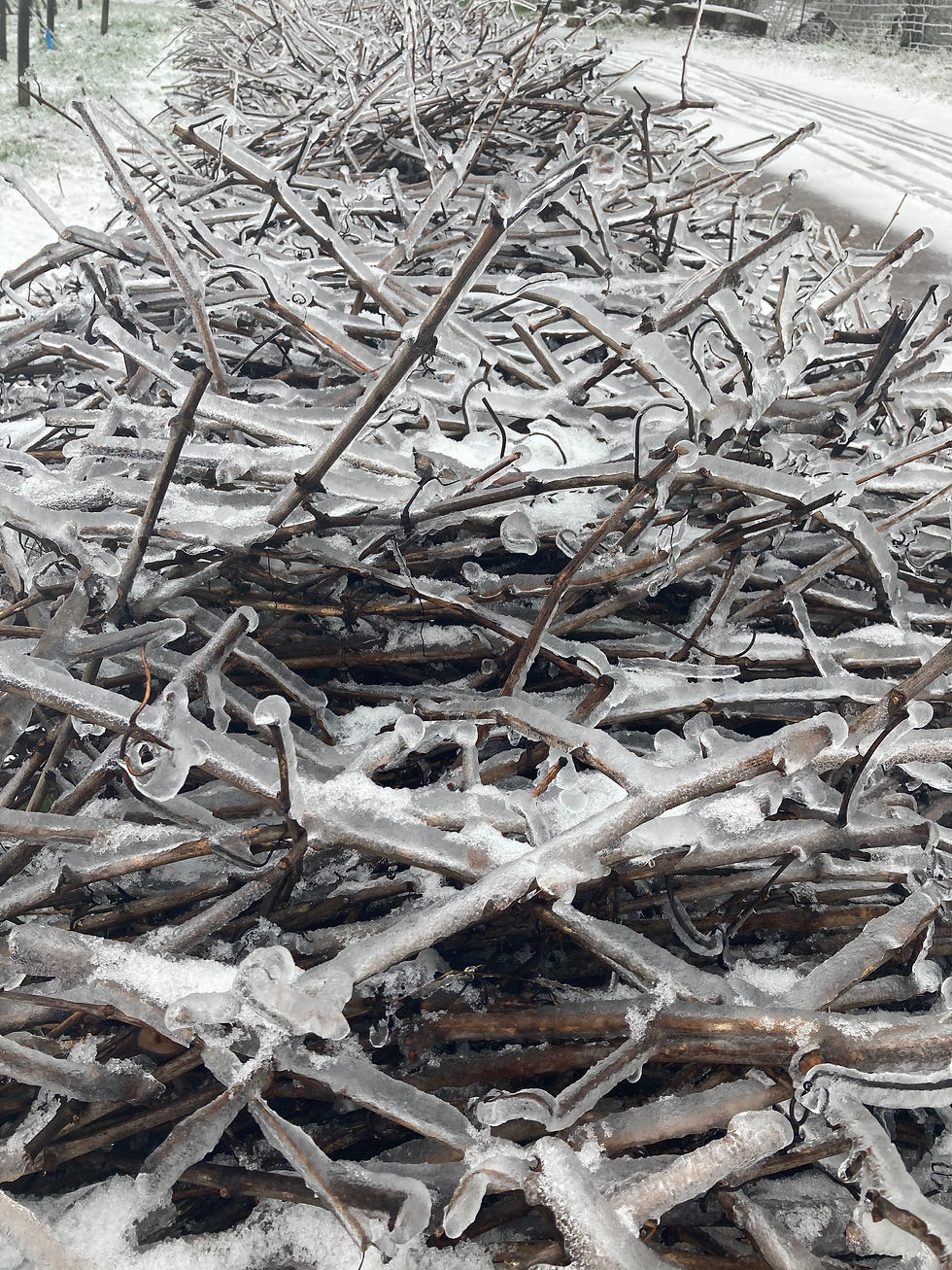
The ICE Age
June 24, 2025
The country voted and the man who won garnered 49.8% of the vote. Of course with less than half of the vote, they have taken this as a “mandate” to rid the country of all illegal immigrants.
And so it goes with Immigration and Customs Enforcement (better known as ICE), swarming the countryside in search of anyone they can arrest. While we can all agree that the immigration system in this country is seriously broken, I do not believe that even 49.8% of the voters intended to have millions of law-abiding residents simply rounded up without due process and shipped out of country. The terror that is being perpetrated upon millions of Latino Americans is hard to imagine but it is real.
The agricultural sector of our country absolutely relies on these people to produce the food that we eat. In a quote from the esteemed international wine critic, Jancis Robinson: “California is responsible for approximately 81% of the US’s wine production, more than a third of the US’s vegetable production and three-quarters of its production of fruit and nuts. 45% of all US agricultural workers are undocumented – and that number is higher in California, with some estimates as high as 75%. Almost half of the US’s undocumented immigrant population lives in California.”
At Cameron we also rely on the Latino workforce to accomplish many of the tasks in our vineyards. We simply cannot do it all ourselves. From pruning to pulling leaves around the fruit to harvesting in the Fall, they are a vital part of the process. And without them we will not exist.
It does not take a genius to conclude that if you simply terrorize these people (let alone attempt to deport most of them), the production of food and wine will simply collapse in the USA. For instance, in the recent raids perpetrated upon a citrus packing facility in the Central Valley of California, several dozen “illegals” were arrested. The next day, virtually all of the packing facilities in the Central Valley were forced to close down due to lack of employees.
We in the farming business would love to have immigration solved so that we can hire whoever wants to work for us. But we are hearing absolutely no suggestions from the party in power (or the party out of power for that matter) about how to fix this ridiculous system in which people who actually want to work in agriculture can come here legally to do so.

The Plague
May 15, 2025
There was a time slightly more than 150 years ago when European wine almost disappeared from the face of the earth. The 1850s were a time of great stress on the wine industry from a terrible infestation of Oidium (Powdery Mildew). Without a known treatment, it was wiping out crops across Europe on a periodic basis.
All European wine grapes belong to the genus Vitis, species vinifera and it was known that several different species of Vitis existed in North America. Furthermore, it became apparent that the North American species were uniquely resistant to most forms of mildew including Oidium. So, at several different loci in Europe in the 1860s, vines were imported from various points in North America to begin work on possibly hybridizing them with Vitis vinifera and to attempt to make wine directly from them. Unfortunately, the North American vines showed up with “hitchhikers” in the form of a tiny root aphid known as Phylloxera. While the North American species of Vitis had evolved to exist with the little creature, the poor European vines were utterly defenseless against it.
While there has long been conjecture on where exactly the Phylloxera first showed up in Europe, there has recently been some brilliant genetic analysis of various Phylloxera populations in Europe that suggests that a variety of this root louse (EU-1) was introduced in the south of France in the 1860s possibly at the Montpelier Research Institute. A second variety (EU-2) has been traced back to the Royal Viticultural Station in Austria in 1868. Anecdotal evidence also places another introduction in Spain, again by someone trying to solve the Oidium puzzle.
Because Phylloxera can have a winged form in its life cycle, it can spread with frightening intensity. The plague spread out from the several European loci very quickly, literally within 10 years a major portion of the grapevines in France, Italy and beyond were wiped out. By 1889 approximately 2/3 of vineyards in Europe had been destroyed. The area around Dordogne (just northwest of Montpelier) used the be a significant wine producing region and to this day very few vines grow there. Alto Piemonte once far out produced Barolo and Barbaresco with Nebbiolo and even now the quantity of wine produced there is a drop of what it once was. Fortunately for France and the wine world, when the scientists in Montpelier realized what they had possibly unleashed, they swung into action and showed that European budwood could be grafted successfully onto North American rootstock. Of course, this meant that almost every vineyard in Europe had to start over once rootstock became available.
In California, contaminated grapevines arrived from Europe and the East Coast in the 1860s so the vineyards there also became infected. However, the pest moved much more slowly because unaccountably Phylloxera on the west coast does not have a winged form in its life cycle. When the vineyards at Cameron Winery and Abbey Ridge were first established, Phylloxera was not yet present in Oregon. We planted “own rooted” European vines, which are much more easily established than grafted vines. But when Phylloxera finally found its way to Oregon (in the late 80’s or early 90’s), we had to figure out appropriate rootstocks for our soils and learn how to graft. At the present time, around 70% of Clos Electrique has been replaced with grafted vines. But well over 90% of Abbey Ridge is still own rooted. Sadly, there are lenses of Phylloxera appearing at Abbey Ridge so we are now furiously making young grafted vines to replace the ones that succumb to the disease.
Grafting and replanting new vines has a silver lining. We can replace vines with clones that make more interesting and improved wine. For example, in the Pinot gris block at Abbey Ridge, Bill Wayne many years ago found a mutant vine that produced grape clusters with darker color. As we replace vines in this block with this mutant, it will allow us to produce more of our light red Pinot gris (Supernatural).
And please note that the solution to this problem and to other myriad problems that spring up to plague the wine industry have been solved by basic scientific research at institutions such as UC Davis, Oregon State University, Cornell University, Dijon Viticulture Institute, Geisenheim and countless others around the globe. Without the continuing intervention of scientific research, wine production would literally disappear.


Winter Chores
February 13, 2025
It is a misconception that winter is a time of rest for the vigneron. Now that wines from the just-completed vintage are resting in their barrels, we turn our attention to the vineyard, to blending and to bottling.
The thousands of vines who have just given their all to the 2024 vintage are now ready to start their next cycle. Cold winter weather coaxes the sap in the vines to flow back toward heads, signaling dormancy. They are ready to be pruned. Pruning is a truly Zen-like experience as it is purely between you and the vine, a silent conversation with each vine about its potential for the coming year. Decisions are made about where to leave a spur that will produce a suitable fruiting cane for the following year. Fruiting canes are selected based on the vigor of the vine in the past year. When all of the cuts have been made, the brush is pulled from the trellis and tossed in the vine rows. The brush will later be pulled out of the vineyard and turned into chips which can be combined with pressings from the just-completed harvest to produce a kick-ass compost pile.
In the winery, some of the white wines which have only recently finished their fermentation are now readied for bottling which means cold stabilizing, adjusting acidity and filtering. In late January, the 2024 Giovanni Pinot blanc is bottled, and shortly behind it the magical Giuliano Italian blend is assembled. Red wines that have been sitting in barrique for nearly 18 months are now tasted and the first of that vintage assembled for bottling (the 2023 Willamette Valley Pinot noir).
Other small lots of special wines are being tasted and readied for bottling, including the 2023 Friulano and the 2023 Supernatural of Pinot Grigio. As wines are bottled, they must be labeled and readied for distribution. This is a busy time in Portland and around the valley as we approach retail and restaurants with samples of our new releases. It is always a fun time showing off the just-completed vintage as well as the first reds from the previous vintage!

Innovation and Inspiration from California
January 21, 2022
The Napa Valley in 1979 had an air of confidence that transcended everything else. The Steven Spurrier Paris tasting had occurred just 3 years prior and suddenly the wines of California, and especially the Napa Valley, were on the world wine map. It was a place of innovation where anything seemed possible and seemingly every grape varietal in existence could grow there.
The seeds of this success had been planted a hundred years before when Count Ágoston Haraszthy returned from Europe with a treasure trove of many hundreds of grape cultivars and planted them at his Buena Vista Winery in Sonoma. In the ensuing years other individuals contributed further to the selection of varieties (Paul Masson bringing his famous massale of Pinot noir clones from the Côte de Nuit to Saratoga in 1895 and Ernest Wente bringing delicious clones of Chardonnay from Montpellier in 1912). With excellent vineyard sites in parts of the Napa Valley (and elsewhere), the scene was set for Steven Spurrier’s challenge to some of France’s most significant producers of Chardonnay and Cabernet sauvignon.
And soon many French producers were sending their next generation to California to see what was going on. I was fortunate enough to land a position as Assistant Winemaker at Carneros Creek Winery just west of the city of Napa. It was here in the somewhat cooler bay-influenced climate that Carneros Creek owner Bal Gibson and winemaker Francis Mahoney decided to plant Pinot noir. Their original planting used budwood from Louis Martini, further up the valley, but they soon realized that Pinot noir was a variety that easily mutates and is resplendent with a huge number of clones. In fact it became clear that the great vineyards of Burgundy were not planted to a single clone but rather to a rich variety of clones, each with distinct cluster morphology, flavor, color variations and so on. And it is this mixture (or “massale”) that gives the wines from these famous vineyards their complexity and richness.
Gibson and Mahoney entered into a relationship with a well-known and beloved professor emeritus from the UC Davis Viticulture school, Dr. Curtis Alley. Curtis’s idea was to plant a half-acre plot at Carneros Creek to nearly 20 different Pinot noir clones that he would gather around California. Because he was so well-liked around the state, it was difficult for people to say “no” to him. As a result, the little planting contained clones from many of the best known Pinot noir vineyards in California. He planted them using a “random numbers” table so that the clones were mixed up all over the vineyard. Each vine had its own stake with a capital letter denoting its origin; for example A was from Joseph Swan, E was from Hanzell, P was Chalone and so on. On the second day of my new job I literally met Dr. Alley as he was crawling around on his hands and knees under the vines; I crawled under a vine opposite him and introduced myself. Any emeritus professor who is willing to crawl around in the dirt of his pet project is clearly an amazing person and he made quite an impression on me.
To understand Burgundy, it is necessary to come to terms with the amazing diversity of clones that typify Pinot noir. As the clonal test plot at Carneros Creek grew and matured, it was a revelation just how much diversity existed for this one little grape variety: upright growth, downward growth, high vigor vines, low vigor vines, tiny berried clusters, large berried clusters, anthocyanins that absorbed mostly in the blue part of the spectrum (which means generating very red wines which was more typical of Pinot noir) but also anthocyanins that absorbed predominantly in the red end of the spectrum (which produced wines that were very purple in tone). Some clones had various types of virus (typically leaf-roll virus) which, as it turns out, is often a piece of genetic material that propagates from one generation to the next and causes the chlorophyll to denature late in the growing season. This causes the vines to turn brilliant red or yellow as the accessory pigments show themselves after the chlorophyll fades away. I found this clonal trait to be extremely interesting and it would become an enduring source of fascination. As we made small batches of wine from each clone, the story became even more interesting.
Typically it takes Pinot noir around 100 days from full bloom to maturity. But at 100 days the resulting wines could be dramatically different. For example if one focuses on the aroma of “cherry” which is often associated with Pinot noir, some clones express pie cherry, others dark black cherries, and others a fresh Bing cherry while still others might show dried cherries. The array of aromas and flavors is astounding and leads directly to the conclusion that there is not in fact a “silver bullet” clone. Since the secret of great Burgundies is this amazing diversity of characteristics, carefully selected by many generations of winemakers, it is as if several hundred years of Burgundian winemakers have given us this gift of genetic heterogeneity! And realizing the amazing bequest that was sitting in front me, I intended then and there to make this a pursuit of my lifetime.

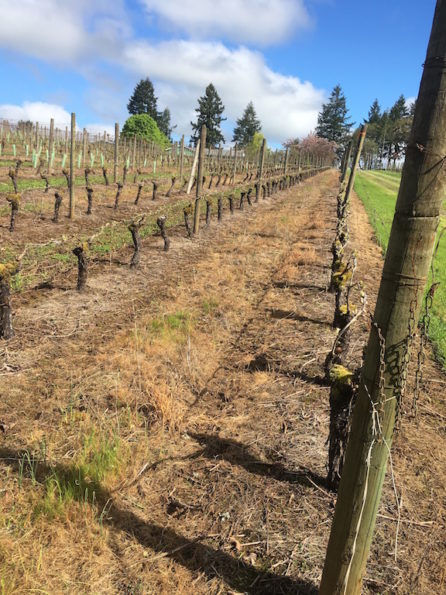

A Natural Wine Begins in the Vineyard
May 10, 2017
The quality of a wine has everything to do with the health of the vines from whence that wine comes. And the mileau within which the vines grow has everything to do with that health.
From the cover crop that grows throughout the vineyard to the microflora in the soil, everything exerts an influence on the final product. Even driving a tractor in the vineyard can compact the soil, affecting aeration and drainage. This in turn impacts the growth of microflora beneficial to the roots of the vines. Therefore, at Cameron Winery, after winter pruning, we remove all of the prunings from the vineyard by hand so that we do not have to introduce a tractor with an attached mower or flail to chop them up when the soil is wet and more compactable.
Influencing what grows in the vineyard (besides vines) and where it grows is a critical part of the process of creating a healthy environment. While we seed with various types of cover crops (clover for nitrogen, buckwheat for phosphorus mining, mustard for drainage and killing nematodes, to name a few) controlling their growth under the vines is always an issue.
We have generally opted over the years to hand mow underneath the vines although this is incredibly labor intensive (see photo).
The alternative, which a majority of vineyards tend toward, is the use of herbicides, of which Roundup (Glyphosate) is by far the dominant player. Glyphosate is a class 2A carcinogen according to the World Health Organization, and has been linked to several types of lymphomas. In the soil, there is evidence that glyphosate is quite toxic to soil bacteria and therefore also inhibits nitrogen fixation by cover crops such as clover and interrupts other important microbial activities in the soil. At Cameron Winery, we are clearly not fans of Roundup and are clearly committed to looking for alternatives.
At the Ecofarm Conference this year, we were introduced by noted root specialist Robert Kourik (the author of Roots Demystified) to a method of mulching. Newspaper is placed under the vines as a base on which we place chipped up vine prunings (see photos below). This is in the experimental phase at this point but we are hoping that it can replace mowing under the vines at least in part. We are also experimenting with no-till techniques to help preserve soil biology, a topic for a future rant.
In the end it is clear that truly healthy vineyards as well as other forms of healthy agriculture require a lot of love and labor. But I can tell you that nothing is more enjoyable than working in and being a part of a healthy vineyard.

What Makes a Vintage Fabulous?
December 2, 2014
Whenever a vintage gives us beautiful fruit to vinify, discussion often revolves around “why?”. Some growers will tell you that it was the meticulous manner in which they cared for the vineyard. Some winemakers will strut around attempting to take credit. But the truth always lies in the vagaries of weather. And generally the vagaries are most important in the spring (around bloom) and in the Fall (just prior to harvest). Even the previous vintage (with its effect on primordial bud development) can be equally credited.
So this brings us to 2012 which is getting lots of positive press. The crop ended up tiny overall in 2012 and for the most part this was due to necrosis of the grape flowers. With necrosis, the promising little flowers simply dry up and, for a while at least, sit there tormenting the grower with what could have been! In 2012 a warm early Spring initiated substantial growth and the roots responded with ample ammonia to fuel the early growth. But then, just prior to bloom, the average temperatures dropped precipitously, growth stalled and the ammonia levels started to rise (apparently nobody thought to tell the roots to cool it). When ammonia levels start to become toxic, the floral parts of the plant are particularly sensitive and necrosis results.
What this meant overall for the developing 2012 vintage was that the crop would be small. In our vineyards, it would average less than 1 ton per acre (or around 13-14 hl/hectare). These are tiny yields of considerably less than half of normal. As we proceeded through a warm, pleasant summer the crop slowly ripened. And then we hit almost perfect Fall weather: cooler than average night temperatures (which preserves acidity) and warmer than average daytime temperatures (which aids ripening). And to top it off, we experienced absolutely clear weather from the 22nd of
September to the 12th of October which covered the bulk of harvest.
The result is wines of high intensity (due to the small crop), perfect ripeness (due to the Fall weather) and high acidity (due to cool nights). And while the intensity on these young wines makes them seem a bit “un-Pinot noir-like”, they will show their mettle as they age.

Summer on the Tractor
July 20, 2014
The roosters in the vineyard start to crow. It is 5 a.m. The eastern sky is showing that a new day will soon be upon us. Teri and I have spent the night in the yurt after an evening of revelry in front of it! I roll out of bed; my old dog thumps her tail but makes no other movement; Teri buries her head under her pillow as I tiptoe out of the yurt, carrying a bundle of clothes.
The tractor is in place, sprayer attached, ready to roll. I quickly consult my notes: 4# sulfur per acre X 2 acres per tank; but my scale weighs in grams so 8# becomes 3.64 kg (I am happy to note that my college days of using a metric balance to weigh out 1 oz portions is still useful!). The sulfur is weighed out and carefully stirred into a 5 gallon bucket.
My tractor, which has been idling for a several minutes, is now revved up to 2700 rpm, the PTO engaged and sprayer rumbles to life. Slowly the sulfur mix is poured into the tank and a man looking somewhat like a space alien with respirator, goggles and ear protection climbs on board. Even though sulfur is an organic spray, it stings the eyes and insults my nose!
The clutch is depressed as the stick is slammed into high 1st and suddenly we are ambling toward the first row. The air is dead still, the sun still not showing itself as I swing the lever forward to activate the sprayer. A mist of sulfur hurdles into and over the vines behind me, settling on leaves and young fruit clusters. Everything is working perfectly and I hope that bit of good fortune stays with me over the next 4 hours as I finish one vineyard
block, reload, finish another and so on. I am continuously glancing behind me, taking a quick inventory of how the nozzles are functioning, then eying the pressure gauge, checking the rpm and the tank level.
The sun starts to peak above the horizon. I flip on the music to my head set…the Brandenburg Concerti this morning. The fruit set looks really good, wow, we’re going to have to drop some crop out here. Leaves have been pulled where necessary and the vineyard is in near perfect shape. Life is good.

THE THING ABOUT RAIN
February 19, 2014
When you grow grapes the way we do, depending on Mother-Nature to provide us with ample moisture through the year, the advent of the winter rains is a welcome indicant of the year to come. Without sufficient moisture in the soil, it is of course more of a struggle for the vines to progress through the summer. With excessive moisture, vine vigor can become excessive. In either case, the state of the vine imprints itself on the resulting fruit.
In the Fall, rain prior to harvest can have both magical and disastrous consequences. At the end of a long, dry summer timely rains will rejuvenate vines, slow down maturation of the fruit and prevent desiccation of the fruit. During the middle of harvest, rain can delay the process as well as contribute to the onset of fungal diseases.
Thus precipitation, how much we receive and when we receive it, is a crucial player in the definition of each vintage. As a result it is also an important contributing part of what we call “terroir”.
As we become more urbanized as a society, wine, especially local wine, provides a picture of this relationship between man and the weather around him. 2011 was a cool summer with a wet autumn and very late harvest and the wines reflect that. 2012, remember that heat in August? That was followed by a little rain in early September to recover the vines and picture-perfect harvest and the wines reflect that. The wines are in essence a picture of the year that was, and how fun is that?!
Turn on the irrigation and you’ve thrown it all away. Turn on the reverse osmosis machine in the Fall and you’ve thrown it all away again. We have a choice here: we can go for consistency from year to year (think “Coca Cola”) or we can go for reflections of the year that was. Obviously we choose option B!
Think pink!
August 2, 2013
Given the present enthusiasm over pink wines, it is hard to believe that there was a time in the very recent past when my best bet at selling pink wine was to put a picture of Ché Guevera on the front label and call the wine “Vino Pinko”. Now, thankfully, that has all changed. Rosés, ramatos, rosattos, pink wines or whatever you want to call them now have an ardent following and so they should.
These wines bridge the gap between white and red wines and may be more versatile than either of the other two. If made properly they can possess the acidity more common to white wines with some of the texture commonly found in reds.
And to make them properly requires some skills above the norm for making most wine. That is because “balance” is more difficult to achieve in these wines given the contact with the skins which will extract sometimes bitter phenolics (tannins) without the more forceful flavors inherent in red wines to offset them. It becomes a game of restraint versus extravagance; pulling out sufficient color and texture while leaving the wine buoyant and fresh at the same time.
Too often producers of pink wines overburden them with sulfur dioxide and kill the freshness. Or they extract too much color and tannin and leave them in no man’s land between rosés and reds. In the other direction they shy from extracting sufficient color and texture and leave them in a place where they are in actuality more blanc de noirs than rosés.
The perfect pink wine, and there are many good ones out there, possess beautiful tones of color from orange to salmon pink to light strawberry. They should have a hint of texture reminiscent of the grape from which they emanate. There should be of firm acidity but not at the expense of the delicate flavors inherent in these wines. In short, one should be drawn in to the wine by its color, captivated by its elegant aromas and finally conquered by its texture and lingering flavors.
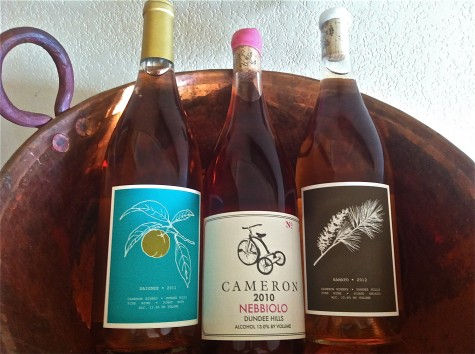
To this end, we at Cameron have released (Summer 2013) an array of 3 pink wines from 3 different vintages, all fermented and aged in older neutral barrique for appropriate periods of time: 2010 Nebbiolo Pink (a late, cool vintage in which this variety was better suited to the realm of rosatto), 2011 Saignee of Pinot noir (feremented juice bled from fermenters of Abbey Ridge and Arley’s Leap Pinot noir) and 2012 Ramato of Pinot grigio (traditional Friulian Pinot grigio macerated on the skins for less than a day, pressed and fermented).